What are fractions?
A fraction represents a part of a whole. It's written with two numbers separated by a line: the top number is called the numerator, the bottom one the denominator. The denominator says how many equal parts the whole is divided into; the numerator says how many of those parts we're taking.
Fractions are one of the most abstract concepts in primary school. The breakthrough comes when the child understands that they're a way of writing numbers "between the whole numbers" — for example, 1/2 sits between 0 and 1.
The mechanism: numerator, denominator and visualisation
To understand fractions you first need a mental image: a cake divided into equal slices. The denominator says how many slices it's cut into; the numerator says how many slices we take.
Denominator
Goes below the line. It's the number of equal parts the whole is divided into. In 3/4 the denominator is 4: the cake is in 4 slices.
Numerator
Goes above the line. It's how many of those parts we're taking. In 3/4 the numerator is 3: we take 3 of the 4 slices.
Equivalents
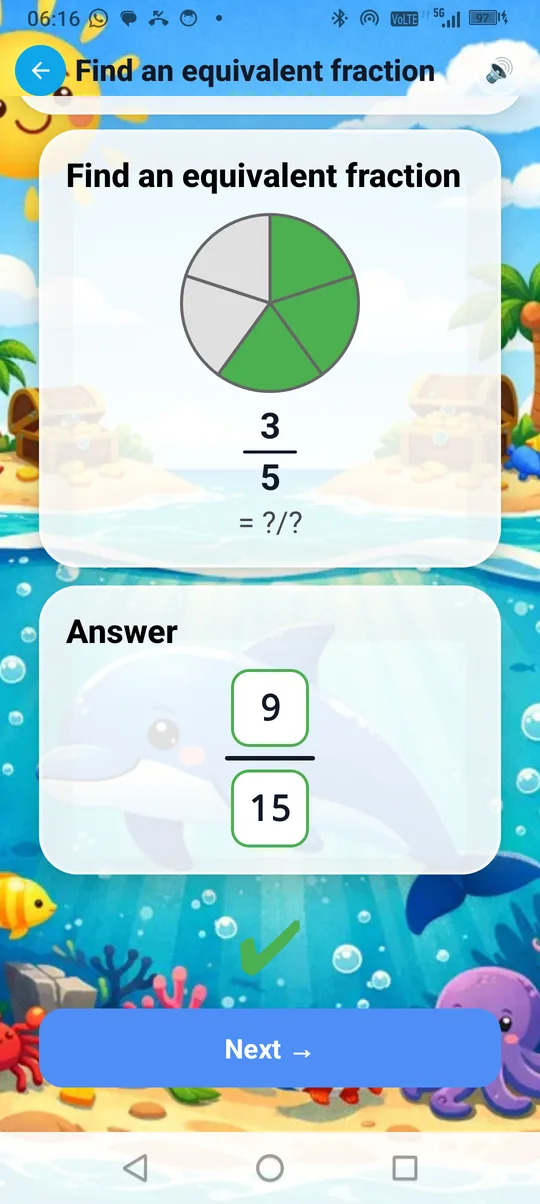
Two different fractions can represent the same amount: 1/2 equals 2/4 and equals 5/10. The "cut" changes, the quantity doesn't.
Worked example: 1/3 + 1/5
- Check the denominators: 3 and 5 are different. We need a common denominator.
- Find the least common multiple: LCM(3, 5) = 15.
- Convert the fractions: 1/3 = 5/15 (multiply top and bottom by 5), 1/5 = 3/15 (multiply top and bottom by 3).
- Add the numerators: 5 + 3 = 8. Keep the common denominator.
- Result: 1/3 + 1/5 = 8/15 (already in lowest terms, can't be simplified).
Same value, different "cut". Once the denominators are the same, you just add the numerators.
Tip: explain to the child that the denominator "never gets added". Keeping it the same is the golden rule of adding fractions: you change the numerators, not how the cake is cut.
How to explain fractions to a child: pizza and fraction bars
The most natural way to introduce fractions is with food. Take a pizza (or draw one) and cut it into equal parts: each slice is a fraction of the whole pizza.
Three pizzas cut into quarters: 1/4, 2/4 and 3/4 shaded
After the pizza, move on to fraction bars: they are more precise because the parts are visually equal, so children can compare different fractions at a glance.
Visual comparison: 1/2 > 1/3 > 1/4 > 1/5
Key rule: the bigger the denominator, the smaller each part. One half is bigger than one quarter!
The 4 fractions practice areas in the app
Matematt organises fractions into four progressive categories, from pure observation to advanced operations. The child follows the order but can always go back to review.
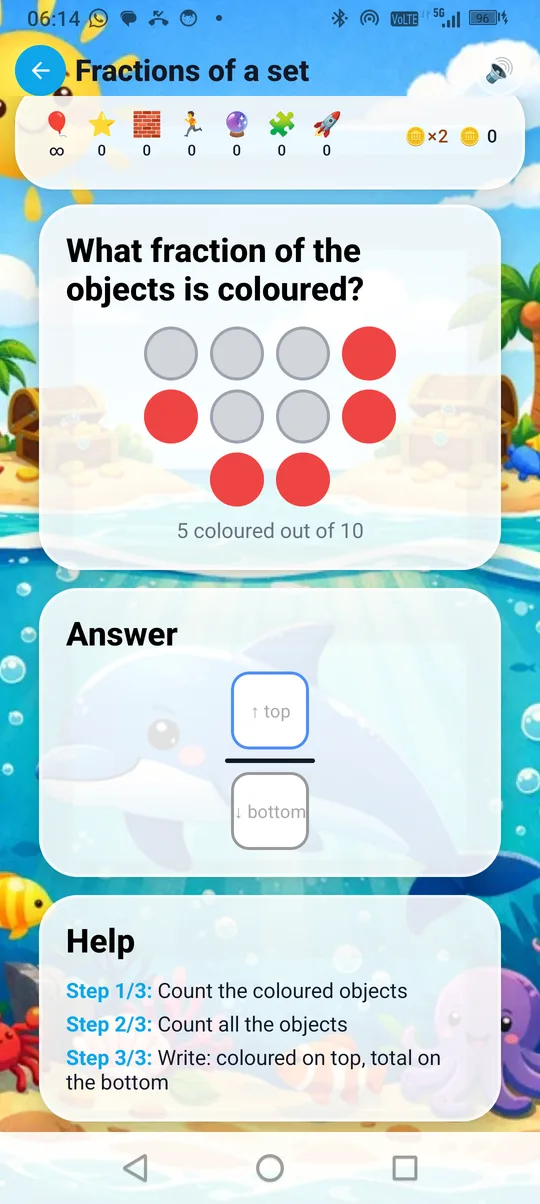
The first step: recognising what a fraction represents. Pizza, sets of objects, number line — three different ways to build the intuition.
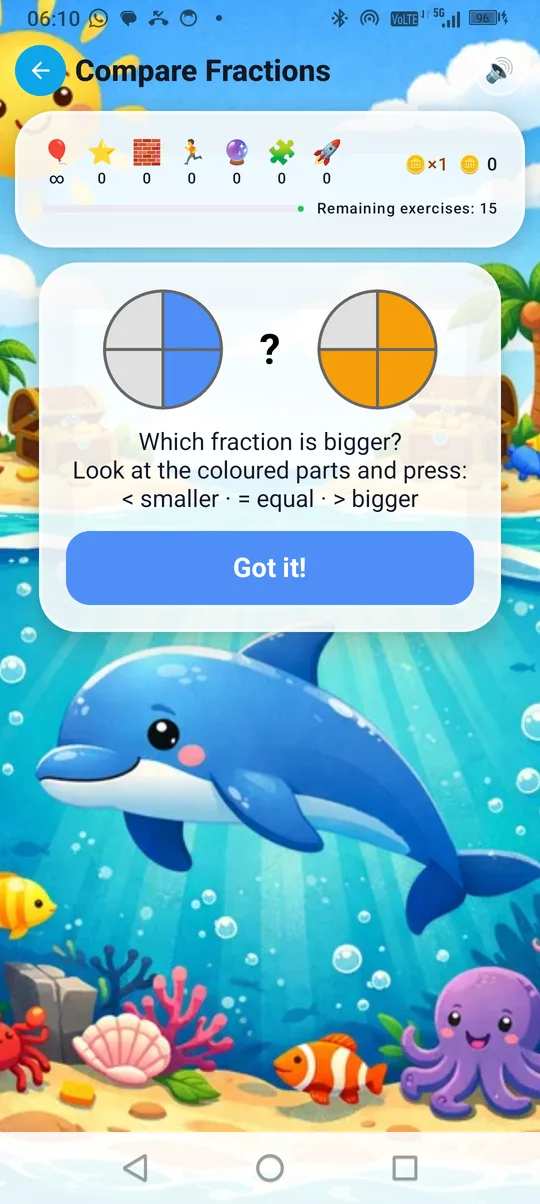
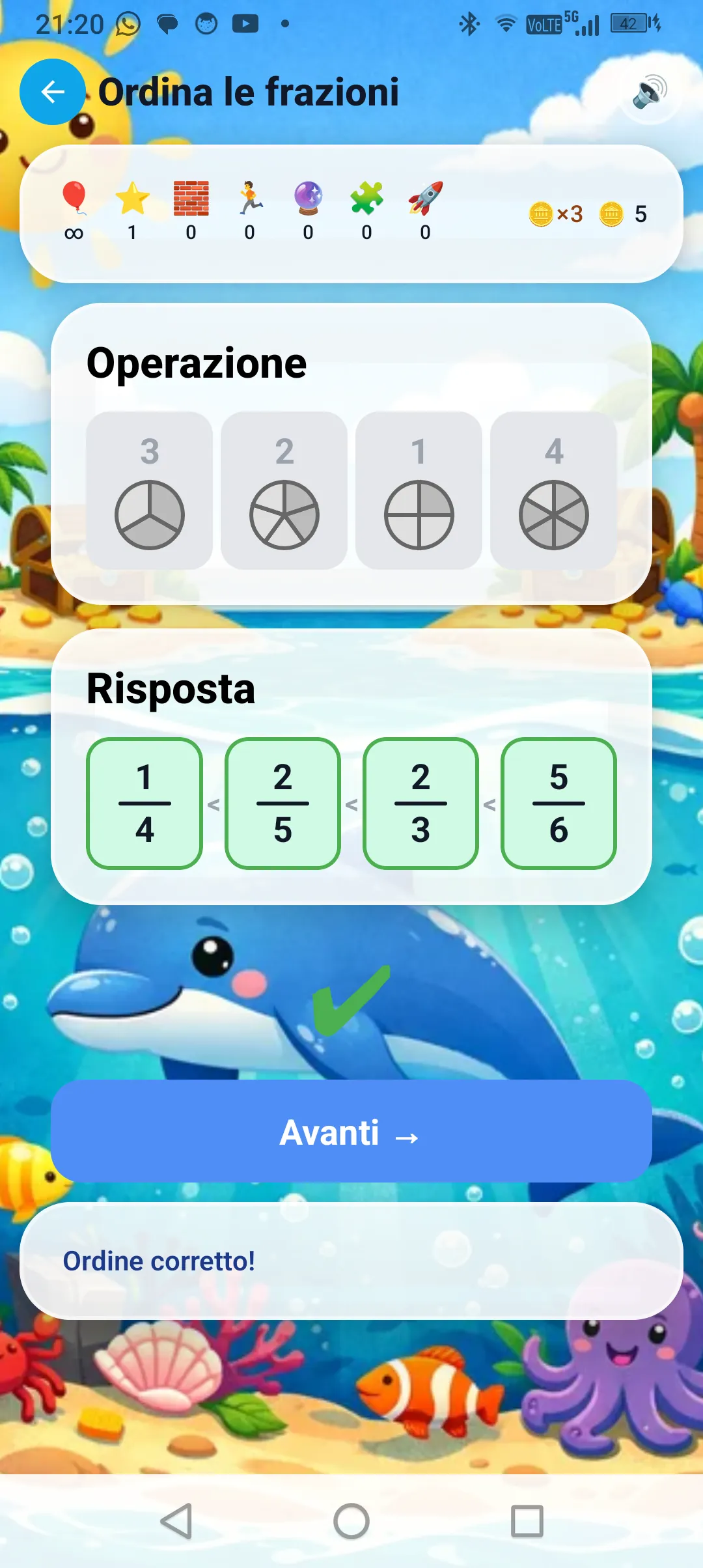
Which fraction is bigger? Put them in order. And discover that 2/4 and 1/2 are the same thing.
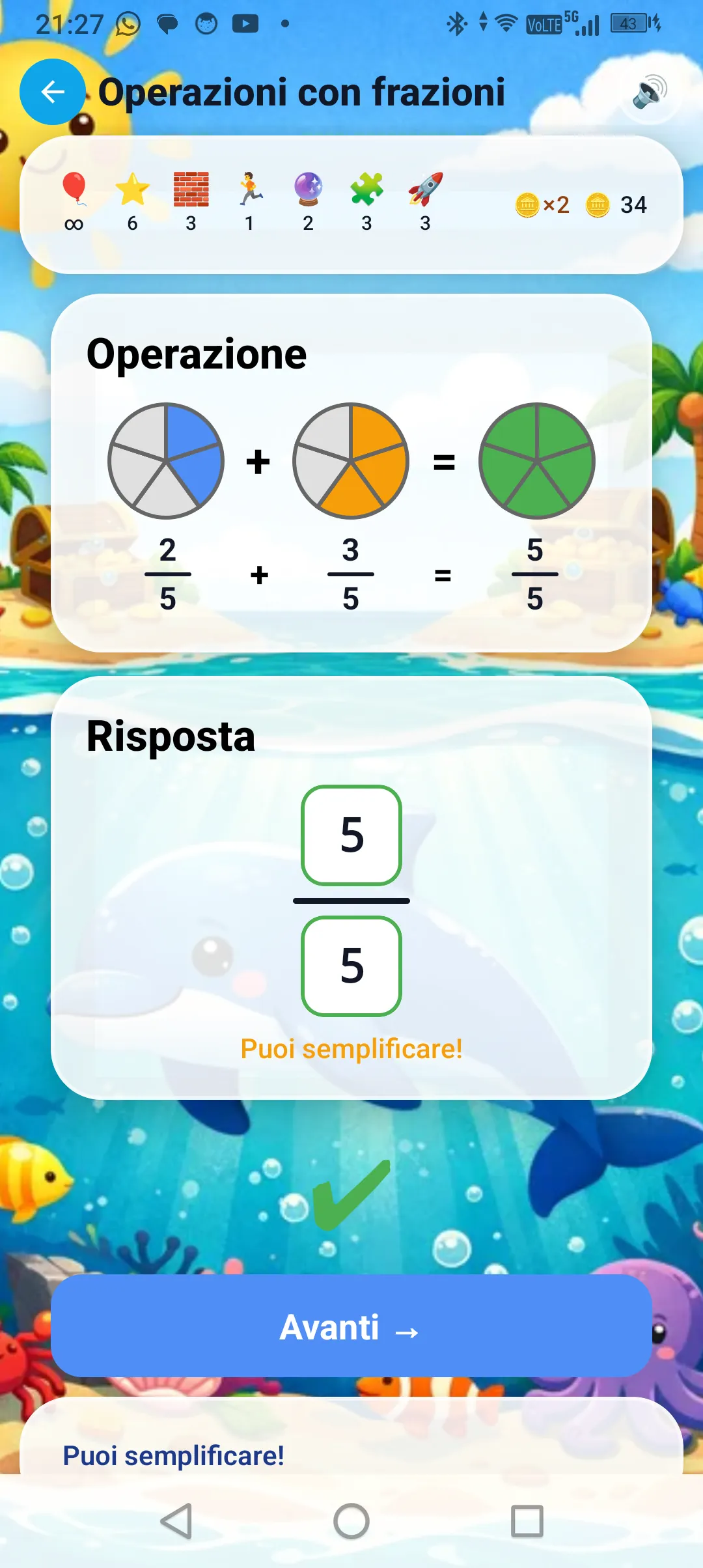
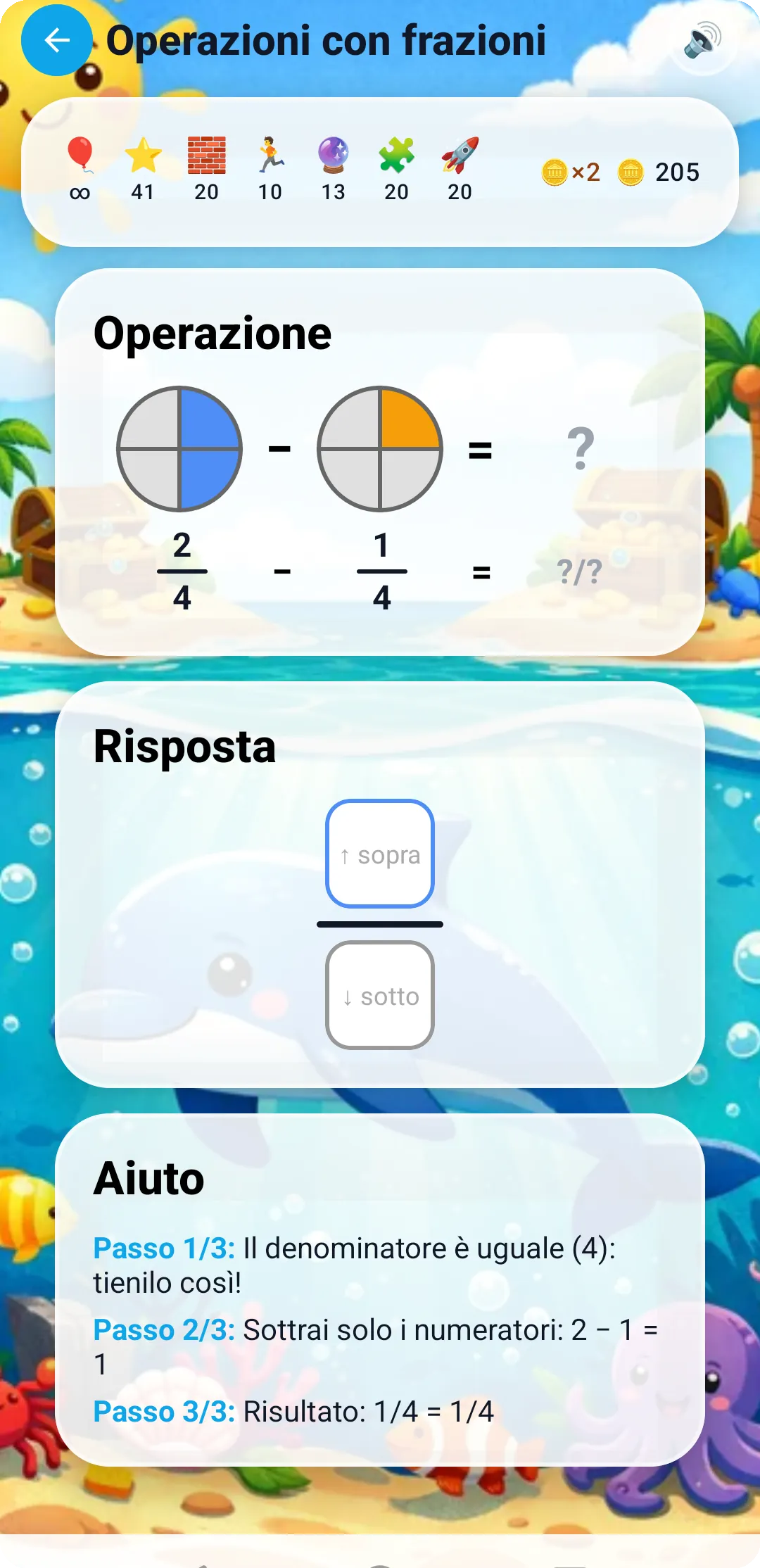
Addition, subtraction and multiplication — with same and different denominators. Plus simplifying to lowest terms.
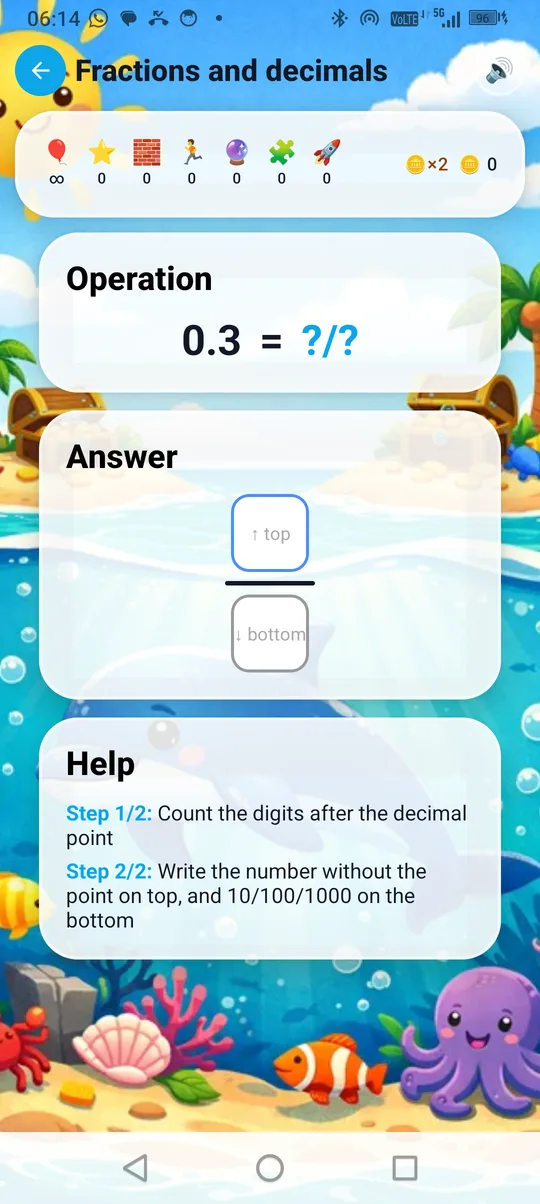
Mixed numbers, fraction of a number, find the whole, decimal conversion. For when you're ready to make the leap.
When to simplify a fraction
A fraction is in lowest terms when numerator and denominator have no common divisors other than 1. Simplifying means dividing both by their greatest common divisor.
6/8: 6 and 8 are both divisible by 2 → 3/4. Now 3 and 4 have no common divisors: it's the simplest form.
9/15: 9 and 15 are both divisible by 3 → 3/5. Simplest form.
8/15: 8 and 15 have no common divisors (other than 1) → already in simplest form.
The most common mistakes with fractions
Fractions are the area where similar rules get mixed up most often. Here are the four typical mistakes to watch out for.
Adding the denominators too
1/3 + 1/5 = 2/8 is wrong. The denominator never gets added: it represents how the cake is cut, and the cuts don't change when you add.
Mixing up numerator and denominator
On a pizza cut into 4 with 3 coloured slices, the child writes 4/3 instead of 3/4. On top goes how many parts you took, on the bottom the total.
Forgetting to find the LCM
The child tries to add 1/3 + 1/5 directly, maybe by multiplying the denominators (15) without correctly converting the numerators.
Not simplifying at the end
The answer 4/8 is correct but not finished: it has to be reduced to 1/2. The "simplest form" is what gets written in school.
How Matematt helps the child overcome the problem
Fractions require multiple steps (LCM, conversion, addition, simplifying) and the child tends to lose the thread. Matematt makes every step visible and pairs every number with a pie representation.
Pie visualisation
Every fraction comes with a coloured pie. The quantity is no longer abstract: the child sees it.
Step-by-step help
For operations with different denominators, the help walks through the LCM first, then the conversion, then the addition — one step at a time.
Guided simplifying
When the result can be simplified, the app flags it and offers the reducing-to-lowest-terms exercise.
Mistakes as opportunities
If the child also adds the denominators, the app doesn't just mark the error: it goes back to the step where "the denominator doesn't get added".
Fractions practice problems
Start with fractions with the same denominator, then those with different denominators, then simplifying, and finally the advanced cases.
Adding, same denom.
2/5 + 1/5
Same denominator: just add the numerators. Result 3/5.Adding, different denom.
1/3 + 1/5
The guide's example: LCM 15, result 8/15.Simplify
6/8
Divide top and bottom by 2 → 3/4.Fraction of a number
2/3 of 24
24 ÷ 3 = 8, then 8 × 2 = 16. Fraction of 24 = 16.5 tips for parents
- Use real objects — cut an apple, share out biscuits, pour water into glasses
- Always draw — fractions need visual support, especially at the beginning
- Don't rush — make sure your child understands the concept before moving on to calculations
- Link to everyday life — “we ate half the cake”, “a quarter of an hour to go”
- Practise patiently — fractions need repetition to become natural
Frequently asked questions about fractions
How do you explain fractions to a child?
It helps to start with a cake or a pizza: cut it into equal slices, take some, write above the line how many you took and below the total number of slices. Once the image is clear, the symbol follows naturally.
Why is 2/4 the same as 1/2?
Because "two slices out of four" covers the same portion of cake as "one slice out of two". The cut changes, the quantity doesn't. These are called equivalent fractions and you find them by multiplying or dividing top and bottom by the same number.
At what age are fractions introduced in primary school?
Typically in Year 3 / Grade 3 children meet fractions as parts of a whole; in Year 4–5 / Grade 4–5 they work with equivalents, simplifying and operations with same and different denominators. The UK National Curriculum and the US Common Core both place mastery of fraction operations within primary school.
Does Matematt also teach mixed numbers and decimals?
Yes: in the "Advanced fractions" area there are exercises on mixed numbers (2 3/4 + 1 1/2), fraction of a number (2/3 of 24), find the whole (1/4 of ? = 9) and fraction-to-decimal conversion (0.3 = 3/10).